
The $10 Million Filing Cabinet
Why 21st-Century Tech Fails with 20th-Century Habits
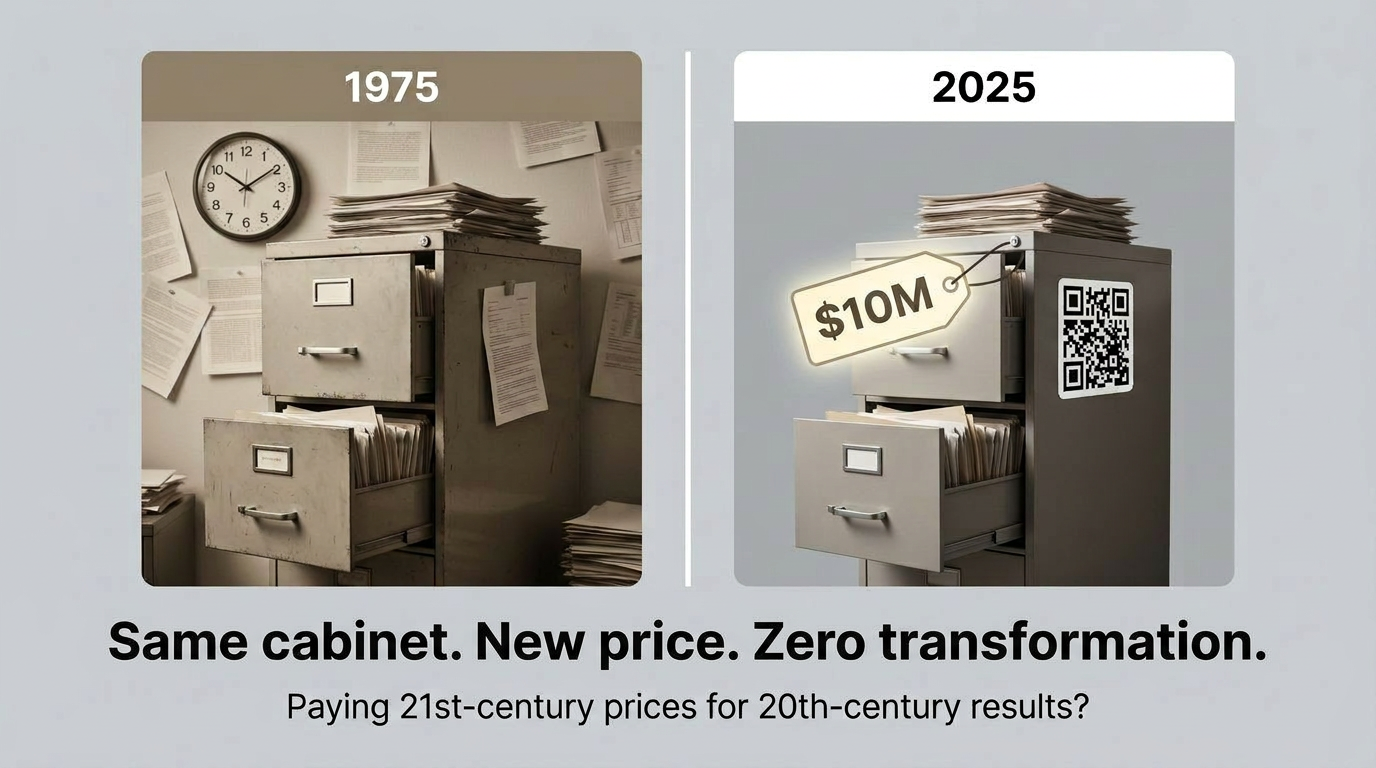
Imagine an organization that invested $10 million to build the ultimate digital workspace. The vision was bold: a state-of-the-art, cloud-based collaboration suite designed to kill redundancy and spark real-time innovation. No more "where is the latest version?" No more silos. Just one "single source of truth" where teams could solve problems at the speed of thought.
The leadership team was energized. They weren't just buying software; they were buying speed. They were evolving past the era of passing folders from desk to desk, moving toward a future where decision-making happened in seconds, not weeks.
Then came the Go-Live.
Six weeks later, the IT team conducted a routine audit to celebrate their success. What they found was a digital nightmare.
Despite the shiny new interface, the audit revealed that employees were still tethered to the past. Critical files weren't in the cloud; they were buried in local hard drives. The "real-time" collaboration? It wasn't happening. In fact, reports surfaced of teams printing out drafts, marking them up with red pens, and sending them across the building via inter-office mail.
A walk through the office confirmed the nightmare: cubicles were still anchored by heavy filing cabinets, stuffed to the brim with paper graveyards. Older editions of policies and design materials that should have been digitized years ago were still occupying valuable space.
The company had spent $10 million to move into the future, but their habits had kept them firmly in 1995. What went wrong? They installed the technology, but they forgot to implement the old behaviors.
“We often adopt new technology, but we bring our old habits with us. So instead of changing how we work, we simply recreate the old system with newer tools.”
The Multiplier Effect: Mastering the GE Change Effectiveness Equation
Too often, organizations pour millions into state-of-the-art technical solutions while investing next to nothing in the human practices that drive behavior change. The result? A Ferrari-level technology paired with a horse-and-buggy adoption plan.
In the late 1980s, the team at GE distilled this pathology into a simple but brutal formula known as the Change Effectiveness Equation:
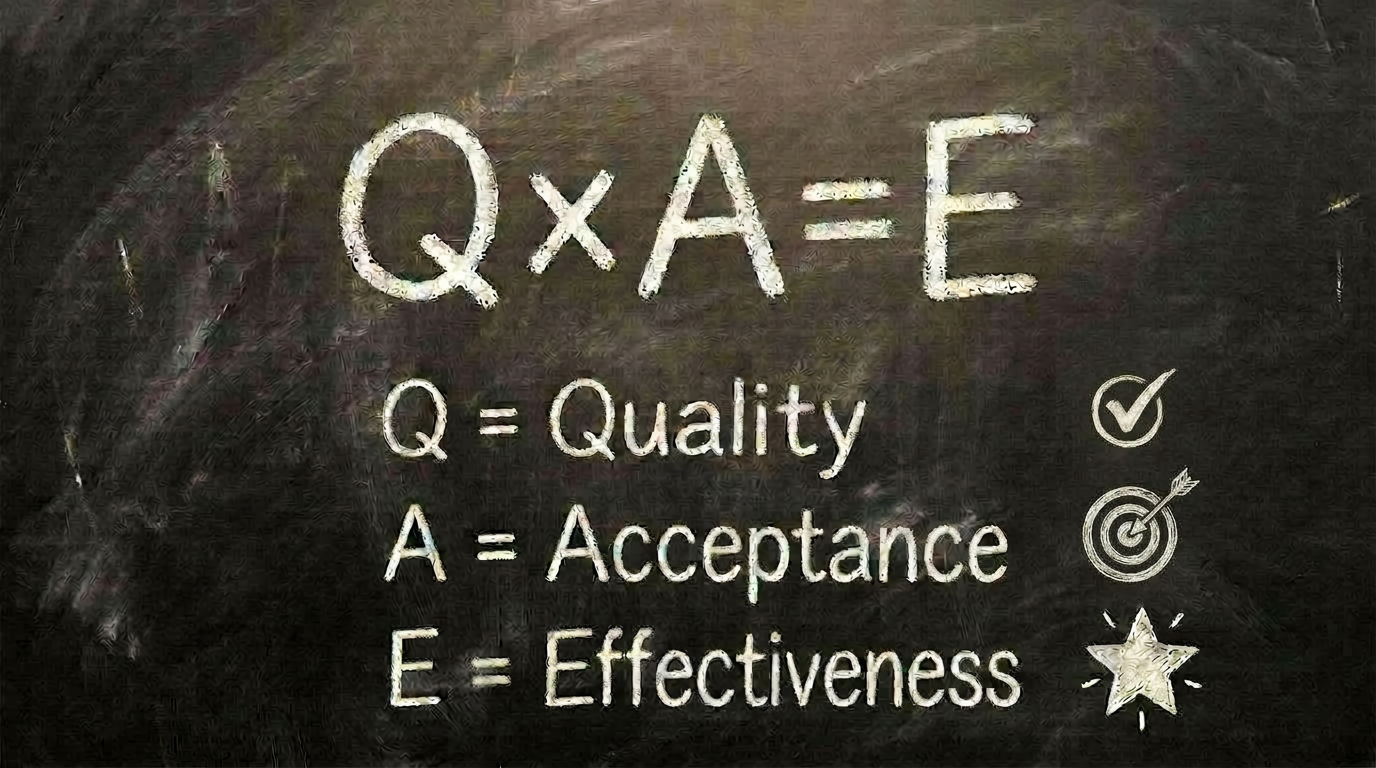
Q (Quality): The technical excellence of the solution (The "$10 Million Cloud Suite").
A (Acceptance): The degree to which the people affected embrace the change (The "Behavior").
E (Effectiveness): The actual result or ROI achieved.
When you do the math, the danger becomes clear: zero is a contagious number. If you spend your entire budget on the Quality of the tech but spend nothing on Acceptance, or what I call the "Triple A" of Alignment, Adoption, and Accountability, you effectively put a "0" in the equation. And in mathematics, anything multiplied by zero is zero. Your $10 million investment yields a $0 return.
Conversely, the "A" is your greatest lever. You can take a "so-so" solution—a "Q" that is just okay—and by going "gangbusters" on the Acceptance side, you can turn a mediocre tool into a transformation that the entire organization gets behind.
The technology is just the potential; Change Management is the power that actually turns that potential into results.
You don't get a return on what you install but on what is implemented
Installation vs. Implementation: Insights from Don Harrison’s AIM Methodology
To truly bridge the gap between a $10 million investment and a real-world return, we have to look at the work of Don Harrison, the developer of the AIM (Accelerating Implementation Methodology).
Harrison pushes leaders to understand a vital distinction that most organizations miss: the difference between Installation and Implementation.
Installation is a technical act. It’s "Go-Live." It’s when the software is on the server, the hardware is on the desk, and the "Q" in our equation is technically present. If the lights are on, project management says you’re done.
Implementation is a human act. It only occurs when people are actually using the new technology to its full potential. Implementation isn't about the system being "up"; it’s about the system being integrated into the way people work.
In our original example, a project focused only on Installation would celebrate once the cloud suite was accessible. But Implementation Science pushes us further. It demands that we incorporate objectives tied directly to behavior.
To fix our $10 million mistake, the team would have added a plan to influence end-user behavior from day one. IT wouldn't just measure "log-ins"; it would measure "collaboration habits." Leadership would ensure the product wasn't just available, but was being used as designed and transforming that expensive "filing cabinet" back into the high-speed engine of innovation it was meant to be.
The Leadership Mandate: Why Adoption Cannot Be Outsourced
So, the solution is clear: invest in implementation specialists. Hire an army of change management leads who are experts in adoption methodologies and let them ‘fix’ the problem. Right?
Wrong.
Unfortunately, successfully securing full adoption can not be delegated out to a group of outsiders. While outside change experts are necessary for lending their knowledge to an initiative, leading change is a leadership activity. You must have engaged leaders at all levels of the organization who are:
Aligned with the strategy- they must believe in the change that is coming
Skilled in change management methods- they need to understand the processes of organizational change
Attentive shepherds- they can be in the trenches with their team as they move through the change
21st-Century Solutions Require 21st-Century Leadership
Without leaders who model and reinforce the change, you will continue to pay 21st-century prices for 20th-century results.
