
The Alice Dilemma
How a Weak Reinforcement Strategy Erodes Team Trust
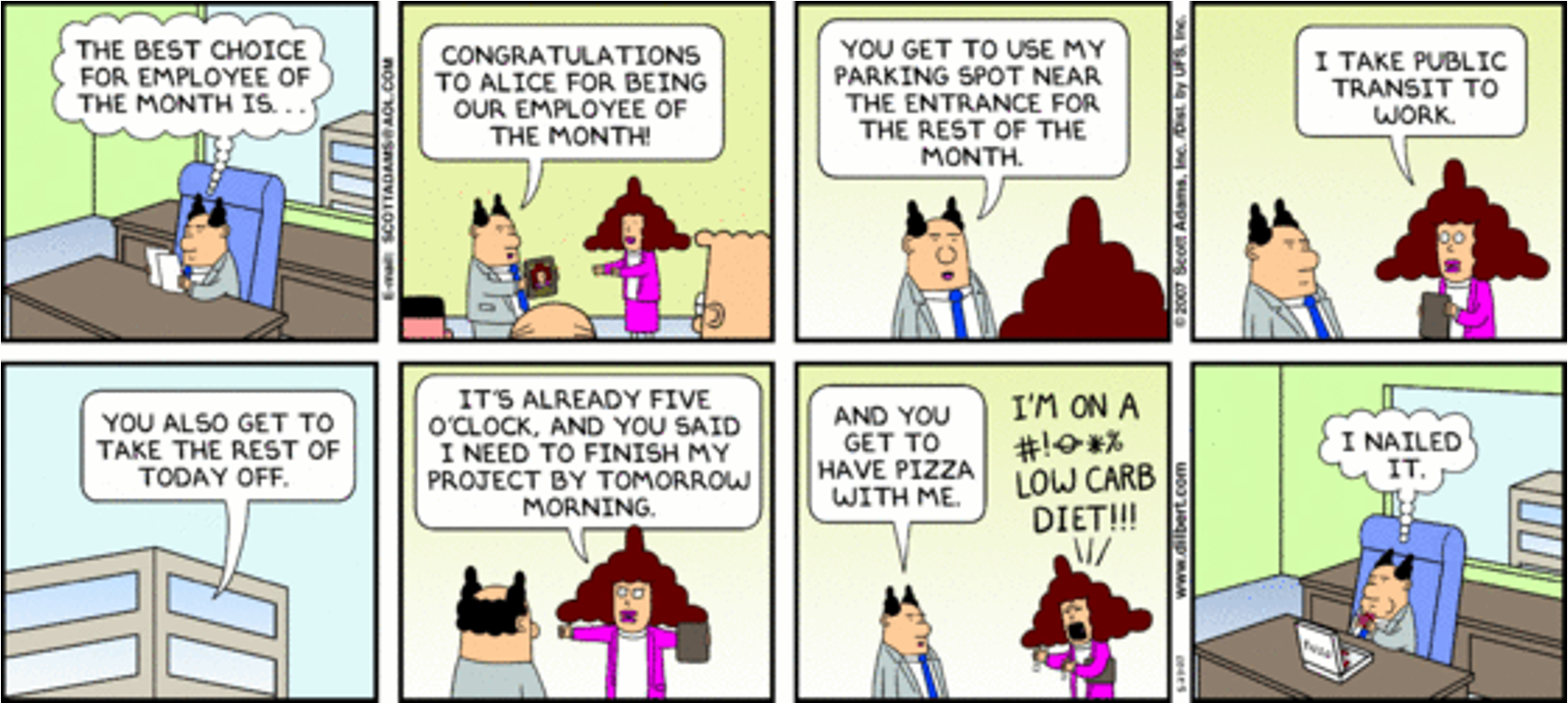
© Scott Adams / Dist. by United Feature Syndicate, Inc.
How many of us can relate to Alice in Scott Adams’ Dilbert cartoon from 2007?
Alice does her job consistently and well. So well, in fact, that her boss wants to highlight her work. He’s clearly hoping others will follow her lead. Unfortunately, he misses the mark entirely. Time after time, he rewards her with "carrots" that are, quite frankly, useless to her:
A prime parking spot… for a woman who takes public transit.
Permission to go home early… when her shift is already over.
Pizza with the boss… when she’s on a diet (and honestly, who wants an awkward lunch with a guy who doesn't know you?)
It’s a funny comic, but it underscores a frustration we’ve all felt: a leader who, at best, doesn’t know us and, at worst, doesn’t care to.
Connecting Poor Reinforcement to Team Health
I spent years at an organization where longevity was highly valued. The leadership team sincerely wanted our organization to be known as an "employer of choice." Yet, at each five-year anniversary, I would receive a catalog in the mail that included a collection of impersonal, low-quality gifts and was told to pick one to "honor my service."
Every time I flipped through those pages, I was struck by the massive gap between their intention and their execution. How much more meaningful would it have been if my manager had been given a small fund to select something that made me feel seen, known, and appreciated? Instead, every five years, I went through a mini-existential crisis re-evaluating my career choices while looking at a subpar branded toaster.
-
Take a look at this video from Daniel Pink (author of Drive: The Surprising Truth About What Motivates Us) and how he challenges a long-held view of a carrot/stick approach to motivation. I have found his framework of Autonomy, Mastery and Purpose to be particularly practical and helpful.
This isn't just about a missed opportunity to recognize an individual’s contribution; it’s about a silent tax on team health. When reinforcement is impersonal, it breeds cynicism. People who feel they are treated like a 'number' will eventually produce a team that checks out emotionally. Effective reinforcement, on the other hand, acts as a social glue in that it validates each person’s contribution to the whole and contributes to a culture of trust.
The Science of Reinforcement
In the field of change management, a glaring paradox exists within the data on reinforcement. First, it is widely recognized as a primary catalyst for making new behaviors stick — the very engine of sustainment. Yet, in a striking contradiction, it is a phase of the change process that employees consistently report as neglected and poorly executed within their organizations.
When leading a team through transformational change (especially one that challenges the existing culture) we must have practices that reinforce the "new way" of doing things. However, for reinforcement to actually work, two things must be true:
It must be personally meaningful. Knowing what motivates your employees drives impact. Why we show up and do what we do is person-specific; your reinforcement strategy should reflect that.
It must be explicit. Employees don’t always realize they are being reinforced. Sometimes, you need to "narrate the win" so the connection between the action and the reward is crystal clear.
The Power of Team Relationships
If you are a leader of a team, you are uniquely positioned to bridge this gap. Knowing what motivates your team and acting on that knowledge isn’t just a management tactic — it’s how you show your team that you actually care.
